Choices for today / Four perspectives

Different roles. Different decisions to make

In-house teams considered which work to retain. Firms focused on services, talent and relationships. Technology providers examined implementation. The consumer and small-business perspective put affordable help, fairness and trust first.

Four groups considered how to respond to all four imagined futures. Their proposals offer starting points for discussion. They are not a shared plan or a record of actions already implemented.

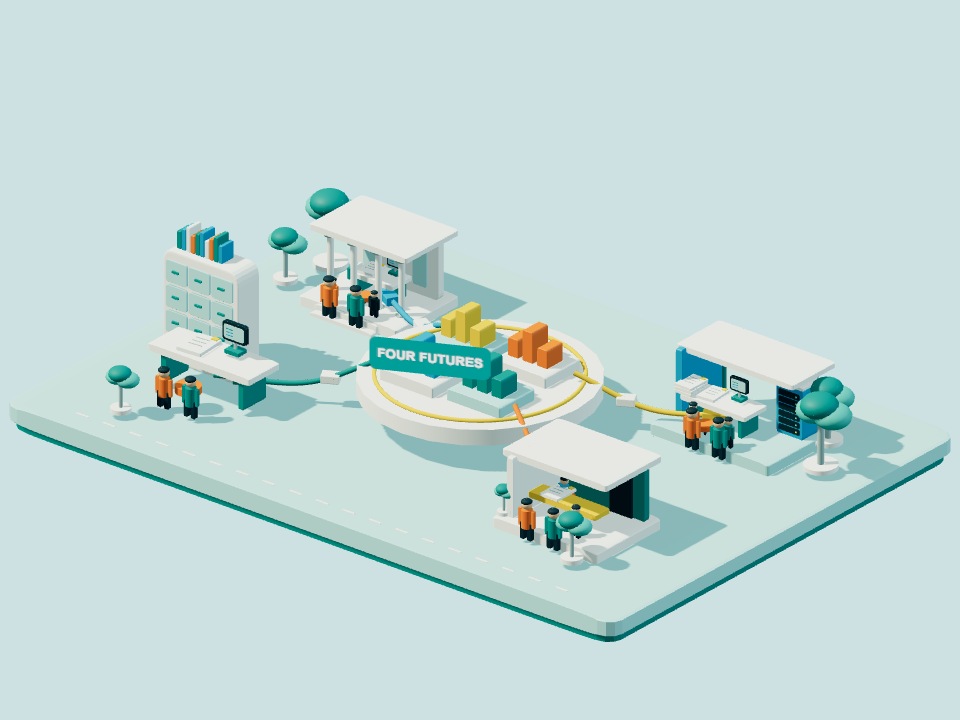
Four groups consider the same four possible futures from the perspectives of in-house legal, law firms, technology providers, and people seeking legal help.
How the groups used the futures
Four groups considered the same four futures.

The teams that created the scenarios were different from these response groups. Each group examined all four worlds from one perspective, so a future can lead to different priorities for a company, a provider or someone seeking legal help.

The groups distinguished proposals they expected to be useful across futures, proposals that depended on conditions, and ways to retain the ability to adapt. Those categories record their judgments, not proven results.

Recorded workshop proposals / In-house legal

Decide what legal should own

The group proposed defining future legal roles around the work involved, the judgment required and the trust placed in people. That would help a company decide what to retain and what to buy from others.

Map roles by work, judgment and trust. Use that map to decide what to retain and what to outsource.

Build an override switch in case of failure.

Promote “minimum standards of legal engagement.” The notes do not specify the standards.

See proposed actions and concerns in each future
Paraphrased group notes. A concern records what participants worried about, rather than a forecast.
Possible futureGroup proposalConcern raised
1. Legal becomes infrastructure.Build a legal service the business can trust, with clear responsibility for its decisions.A machine cannot carry accountability.
2. Legal directs the network.Keep assembling technology that advances business outcomes with legal judgment.Continually having to justify spending.
3. Providers own the platform.Choose partners the company can trust and who remain aligned with the business.Losing control of data handed to others.
4. People claim the final say.Encourage new licenses for different kinds of legal practitioners.The note “Embrace the machine” leaves the balance between automation and human authority open.
Consider for your organization · Guide interpretation

Which capabilities, knowledge and decisions must stay under your organization’s control?

June 24, 2026: in-house legal group. Paraphrased from workshop photographs and the accompanying transcript.
Recorded workshop proposals / Law firms

Rebuild delivery around relationships and capability

The group proposed using technology to improve services while continuing to develop people and client relationships. It raised concerns about slow adoption and the loss of opportunities to build professional experience.

Use technology to improve and diversify service delivery.

Build the data and technology capabilities the new model depends on.

Keep investing in talent and client relationships.

See proposed actions and concerns in each future
Paraphrased group notes. A concern records what participants worried about, rather than a forecast.
Possible futureGroup proposalConcern raised
1. Legal becomes infrastructure.Shift toward proactive advice and counsel.Keep investing in experienced people and professional development.
2. Legal directs the network.Combine technology and services with trust and relationships.No legible caution recorded in the source transcript.
3. Providers own the platform.Explore a combined service or legal services provided as shared infrastructure.Slow adoption and attachment to the status quo.
4. People claim the final say.Stay agile and differentiate through judgment.Concern about the firm’s survival, expressed as “Don’t die” in the notes.
Consider for your organization · Guide interpretation

What will clients still choose you for when more legal production is automated?

June 24, 2026: law-firm group. Paraphrased from workshop photographs and the accompanying transcript.
Recorded workshop proposals / Legal technology

Make the systems work in practice

The technology and alternative legal-services group focused on whether customers can connect tools to their existing work, get them running and see useful results. Its proposals emphasized access to customer data, successful implementation and trusted relationships.

Make tools work with customer systems, demonstrate results and help customers introduce and use them. Build the ability to advocate for the sector.

Secure access to the customer data and systems needed to make the service work.

Stay close to how customers use the service. Invest in relationships and a reputation they can trust.

The available record preserves this group’s overall proposals, but not a complete set of actions and concerns for each future.

Consider for your organization · Guide interpretation

Can customers integrate your tools, see their value and trust how they operate?

June 24, 2026: legal-technology group. Paraphrased from workshop photographs and the accompanying transcript.
Recorded workshop proposals / Consumers & small businesses

Make access and trust part of the design

This group examined the position of people who cannot get affordable legal help or do not trust the process. It proposed broader cooperation and standard practices that make help easier to obtain, fairer and more reliable.

Build support across technology, law and politics for fair treatment, access to help, rights and , including a fair chance to challenge decisions.

Bring separate community and leadership groups together.

Agree on that make legal help easier, faster and cheaper to obtain.

See proposed actions and concerns in each future
Paraphrased group notes. A concern records what participants worried about, rather than a forecast.
Possible futureGroup proposalConcern raised
1. Legal becomes infrastructure.Make the case that access to legal protections supports economic success.Disruption and public revolt.
2. Legal directs the network.Fund shared principles for services that take consumer needs into account.Disruption and public revolt.
3. Providers own the platform.Build due process, fair treatment and transparency into the standard settings of services.Concern about social unrest, expressed as “Fire in streets” in the notes.
4. People claim the final say.Reconsider licensing and rules about who may provide legal help.Apathy and alienation.
Consider for your organization · Guide interpretation

Whose experience gets better, and what recourse do people have when the system fails them?

June 24, 2026: consumer and small-business group. Paraphrased from workshop photographs and the accompanying transcript.
One concrete proposal / In-house group
“Build an override switch in case of failure.”

The in-house group proposed this as a response to possible failure. It raises a practical question: whether a person would have the information, skill and authority to stop an automated process. The record does not establish that the groups agreed on an override standard, or that one was built.

In-house strategy wall, June 24, 2026
Decisions still open / Guide interpretation

Proposals need owners, resources and a test of success

The recorded work stops short of an agreed delivery plan. These questions can help carry the discussion into an organization.

Who would take responsibility?

A proposal needs someone to lead it, resources to carry it out, and a way to assess whether it helps.

Could a person intervene effectively?

A right to challenge an automated decision depends on usable information, relevant expertise and authority to act.

Whose experience needs to be tested?

A group considering consumers and small businesses cannot represent every affected community. Their direct participation would help test the proposed benefits and expose missing needs.

PUT THE IDEAS TO WORK
Test a current decision against the four futures